
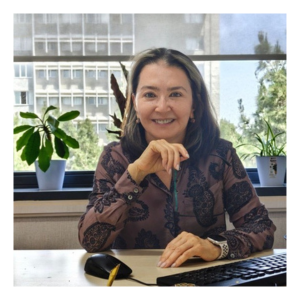

Professor Nurulla-Khoja works at the intersection of intellectual history, decolonial thought, and the cultural heritage of Central Asia, with a particular focus on the Silk Road and its afterlives.

RESEARCH
Nargis’s work unfolds across several lines. One thread traces the intellectual and spiritual genealogies of the Silk Road — Sogdian social structures, Sufi cosmopolitical principles, the transmission of astronomical knowledge from Ulugbek to Copernicus. Another examines how Central Asian societies have negotiated, resisted, and reconfigured the categories imposed on them by imperial and colonial epistemologies, from the Russian Empire through the Soviet period to the present. A third, more recent line, developed through her work at the Silk Road International University, asks how heritage is assembled and narrated — what gets preserved, what gets silenced, and what the museum and the university owe to the neighbourhoods around them.
Her forthcoming book, A History of a Neighbourhood in Samarkand, is an intimate study of a single mahalla across centuries — part microhistory, part palimpsest.
Research Interests
- Intellectual history of the Silk Road and Islamicate world
- Decolonial theory and Central Asian epistemologies
- Sufism and cosmopolitan thought
- Museum education and heritage narration
- Gender and post-Soviet social transformation
- Sogdian and Timurid history

PUBLICATIONS
Books
Cultural Heritage in Tourism: Narrating the Cultural Heritage of Samarkand and Surrounding Regions (Samarkand: Silk Road International University Press, 2025).
Echoes of Chiaroscuro: Unspoken Stories of Light (co-authored with Farangis Nurulla-Khoja. Newcastle upon Tyne: Cambridge Scholars Publishing, 2025).
Community in the Central Asian Region: Dialectics of Traditions and Modernisation at the Beginning of the 21st Century (Moscow: University of Culture and Arts Press, 2012).
Gender Stereotypes in Central Asia (Dushanbe: Irfon, 2006).
Articles and book chapters
“‘Temptation’ from Michel Foucault and the Sufi Wanderings of the ‘Historian’,” Questions of Philosophy 9 (2019): 50–63.
“Decolonization through a New Understanding of Sufism,” Bulletin of MGIMO-University 3, no. 60 (2018): 139–160.
“De-colonization of Political Borders in Central Asia,” Bulletin of MGIMO-University 6 (2017): 87–101.
“Dancing Merchants Outside the Empire on the Silk Road,” Bulletin of MGIMO-University 1, no. 52 (2017): 119–139.
“Decoloniality of Historical Knowledge and Intercultural ‘Dakhlez’ in Central Asia,” Bulletin of MGIMO-University 4, no. 49 (2016): 16–25.
“‘Imitated’ or Genuine? The Value of Resilience in Sufi-Hamsoya,” in Resilient Communities of Central Eurasia, edited by E. Korosteleva and I. Petrova (London: Routledge, 2023).
“Bridging Past and Present: Reconfiguration of Museum Education,” International Journal of Humanities Education 23, no. 2 (2025): 109–126.
“Reconstructing the Intellectual Neighbourhood: Tracing Ali Qushji’s Influence in Science,” F1000Research (2025).
Forthcoming
A History of a Neighbourhood in Samarkand (2026).
“De-Westphalizing Central Asia: From Soviet Biopolitics to a Silk Road Mentality,” Interventions (minor revisions).
“From Timur to Tourists: Reassembling Heritage in Samarkand,” Tourism Geographies (under review).

TEACHING AND COURSES TAUGHT
- History of the Silk Road
- Sogdian History
- Central Asian Culture and Ethnology
- Islamic Sufi Philosophy (Master’s)
- Gender Studies in Post-Soviet Contexts
- Museum Education and Heritage Narration
- International Relations in the Central Asian Region Future