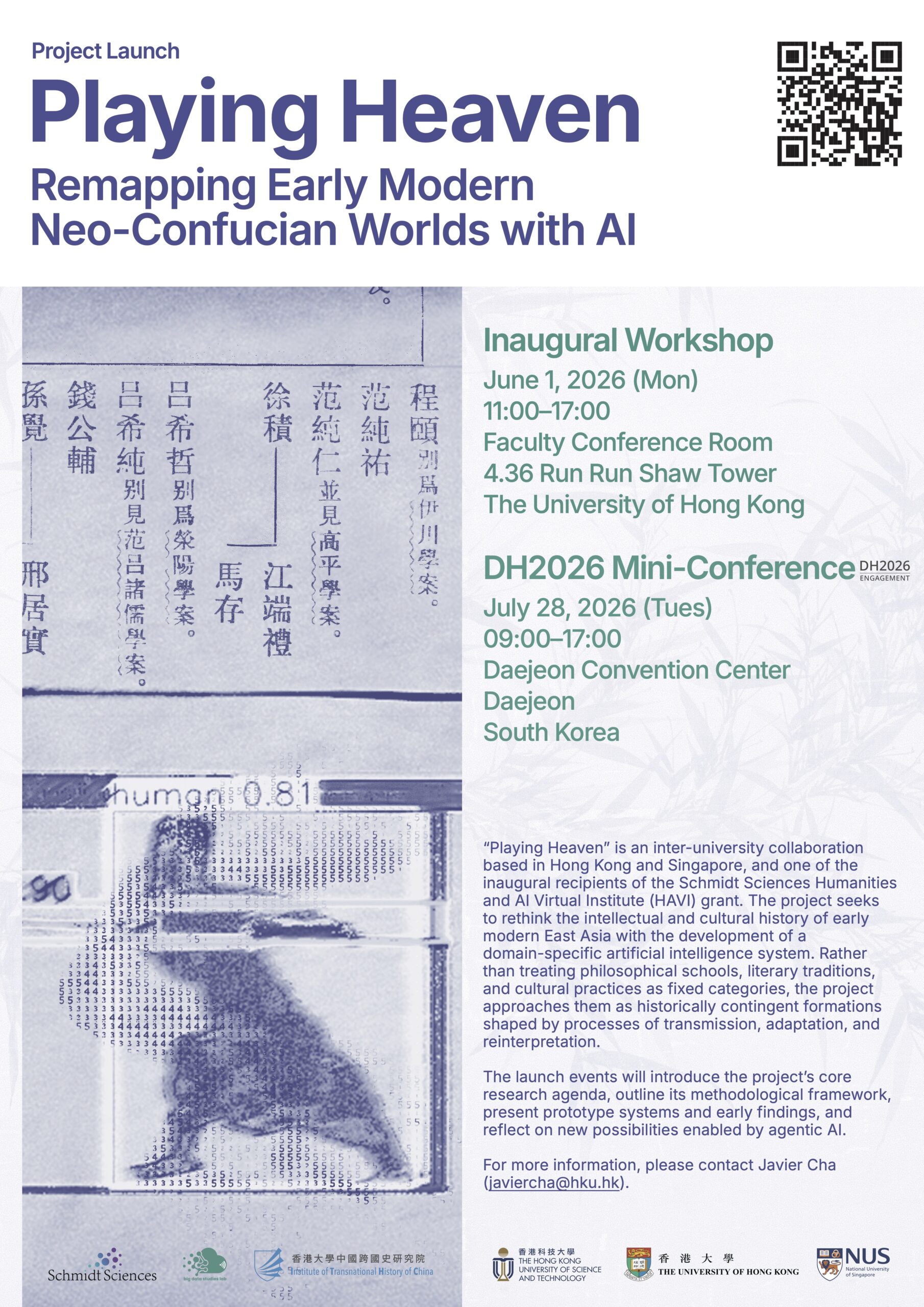
Prof. Javier Cha has been selected as one of the inaugural recipients of a Schmidt Sciences Humanities and AI Virtual Institute (HAVI) grant of up to USD $680,000 (HKD $5.3 million) for the “Playing Heaven” project. Along with his co-PIs Prof. Michael Chung (HKUST), Prof. Yumeng Hou (National University of Singapore), and Prof. Miguel Escobar Varela (National University of Singapore), Prof. Cha aims to leverage transformer-based machine learning to develop robust computational methods for studying the intellectual and cultural history of early modern Neo-Confucianism.
“Playing Heaven” extends Prof. Cha’s longstanding digital humanities agenda, grounded in the conviction that there should be no fundamental divide between digital and non-digital modes of humanities research. In his view, it is problematic to assume that a “digital” approach to historical scholarship necessarily entails quantification or statistical modeling. Rather, when carefully executed, historical research in a digital environment, including one based on AI, should help a historian expand the scale and depth of interpretation.
The project explores this premise in three principal lines of inquiry, with early modern Neo-Confucianism as its focus. First, it converts sources pertaining to schools of thought and literary movements into AI-friendly data formats, such as embeddings and knowledge graphs, to challenge established taxonomies from the ground up. On what basis were such categories originally defined, and could an AI system assist in proposing more refined classifications with clearer justification? Second, it examines the methodological challenges that arise when crossing linguistic and political boundaries, say, from literary Sinitic to Manchu, or from China proper to the Korean peninsula. Third, it investigates whether multimodal AI systems can help interpret embodied traditions inspired by abstract philosophical ideas, such as the putative influences of Neo-Confucian thought on Chinese martial arts.
The project is not defined by any single technological application. While it engages with technically demanding tasks, “Playing Heaven” ultimately recenters one of the most foundational topics in East Asian studies and invites machine-assisted inquiry into interpretive problems that have eluded even the greatest minds in the field. In pursuit of this goal, his team is currently developing a specialized AI system, based on a modular framework known as DeepPast, designed to stand on the shoulders of prior scholarship while opening new avenues of historical analysis and interpretation.
The “Playing Heaven” team is organizing two launch events to be held at the University of Hong Kong on 1 June 2026 and at DH2026 in Daejeon, South Korea, on 28 July 2026. The launch events will introduce the project’s core research agenda, outline its methodological framework, present prototype systems and early findings, and reflect on new possibilities enabled by agentic AI. The events are intended as a forum for exchange and reflection, bringing together historians and digital humanities practitioners to consider how transformer-based machine learning opens new computational approaches to the history of ideas, cultural history, and multilingual historical research—and, more provocatively, how AI agents may begin to move beyond heuristic assistance toward automating substantial portions of a historian’s traditional workflow.
For more information, please contact Prof. Javier Cha (javiercha@hku.hk).
Links:
Schmidt Sciences HAVI 2025 Announcement: https://www.schmidtsciences.org/havi-2025-announcement/
“Playing Heaven”: https://bigdatastudies.net/playing-heaven/
DH2026 Mini-Conference: https://dh2026.adho.org/call-for-papers-playing-heaven-remapping-early-modern-neo-confucian-worlds-with-ai/