

- This event has passed.
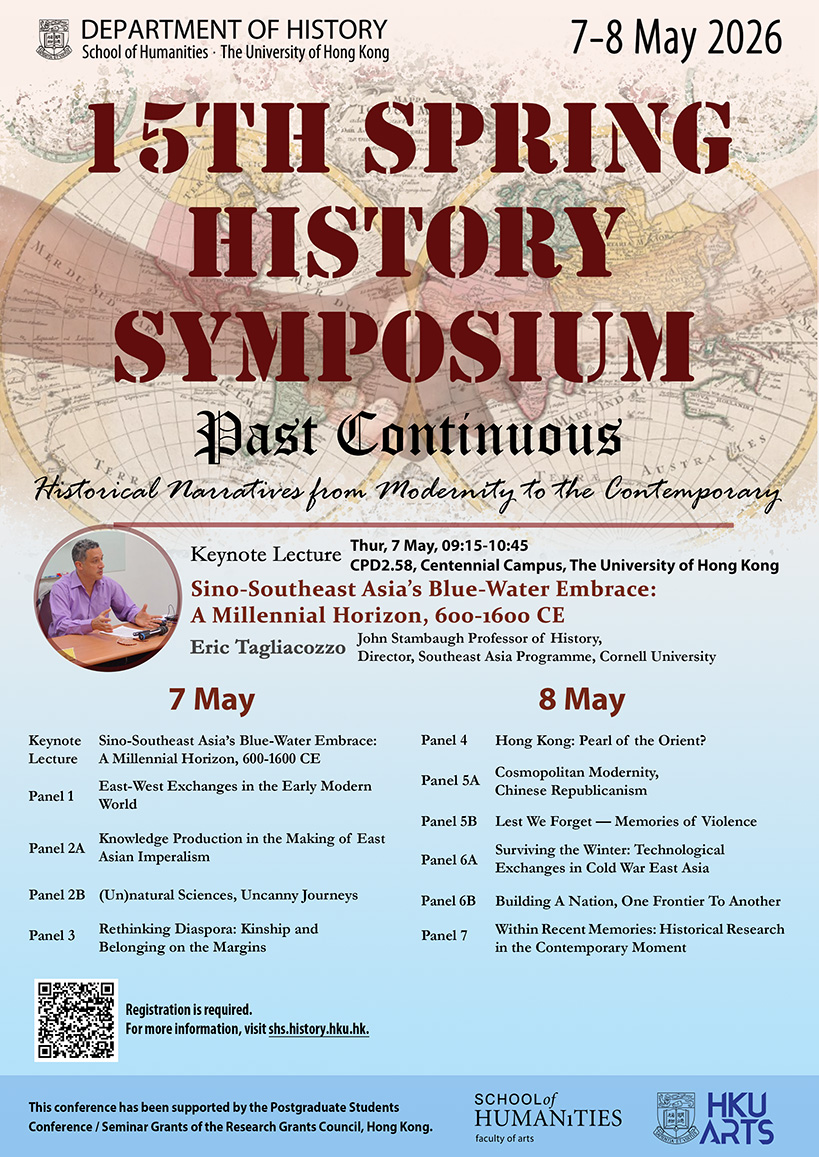
15th Spring History Symposium: Past Continuous – Historical Narratives from Modernity to the Contemporary
May 7 - May 8
In today’s world, societies are facing increasing challenges: trade wars, genocides, anti-immigration sentiments, rising cost of living crisis, etc. The destabilisation of global institutions herald in the decline of mutual understanding and co-operations. The gaps between economic and cultural capitals, gender, race, class, borders, and religions are deepening. In times like this, it is important to cultivate a stable point of reflection and resilience. Searching for a way through, historians always look towards the past: “Those who cannot remember the past are condemned to repeat it”—such is the tried-and-true wisdom. Languages and traditions signal our sense of belonging; literature and culture contain our deepest dreams, hopes, fears, angers and longings; while history unfolds along non-linear trajectories that help us revise, rehearse, and re-shape personal and collective stories from the earliest times to the contemporary momentum.
In 2026, as we celebrate the 15th anniversary of the Spring History Symposium, the Department of History welcomes postgraduate students and early career researchers from around the world to grapple with questions that have been challenging historians from modernity to the present. From macro-histories of events and movements that have (dis)connected Asia and the world from the 18th century onwards; to perennial questions of imperialism and anti-colonialism; war, trauma, and memories; nationalism, regional connectivity and international cooperations; and attempts at re-centring historically marginalised identities—the 15th Spring History Symposium is a timely, if not urgent, celebration of History in all of its past, present, and future glory.
Register here: https://hkuems1.hku.hk/hkuems/ec_hdetail.aspx?guest=Y&ueid=106126
Keynote lecture: “Sino-Southeast Asia’s Blue-Water Embrace: A Millennial Horizon, 600-1600 CE”
Date & Time: 9:15 AM – 10:45 AM, May 7, 2026
Venue: CPD 2.58 (2/F Jockey Club Tower, Centennial Campus, HKU)
Eric Tagliacozzo
John Stambaugh Professor of History
Director, Southeast Asia Program (SEAP)
Cornell University
This talk examines how diasporas, trade, and networks of interaction developed in the “adolescence” of Sino-Southeast Asian contact, in the time-period roughly covered by the thousand years between 600 and 1600 CE. We know very little about the “infancy” of these dealings, in the years before the T’ang. But by that dynasty, patterns of contact slowly began to develop on a more systemic basis, particularly with some of the coastal landscapes of Monsoon Asia, into and including the Indian Ocean. I examine the growth and eventual flourishing of these interactions, especially through the power of commercial networks focused on certain specific commodities, and try to situate them in the larger milieu of what is often called the “maritime silk road”. By focusing on export ceramics heading south, and marine biota heading north, we can learn much about how networks actually “worked” on the oceanic pathways of Asia.
Eric Tagliacozzo is the John Stambaugh Professor of History at Cornell. He is the author of a history of smuggling in Southeast Asia (Yale, 2005) which won the AAS’s Harry Benda Prize in 2007, a monograph on the pilgrimage to Mecca from that region (Oxford, 2013), and a history of oceanic connections in Asia writ-large (Princeton, 2022). He is also the editor or co-editor of a dozen other volumes on a variety of trans-national topics in Asian History, including the Asia Inside Out trilogy from Harvard University Press. He is the Director of the Cornell Southeast Asia Program (SEAP), and serves as one of the two editors of the journal INDONESIA. He was also previously the co-director of the Migrations Initiative at Cornell, a large program funded by the Mellon Foundation on global migrations.